
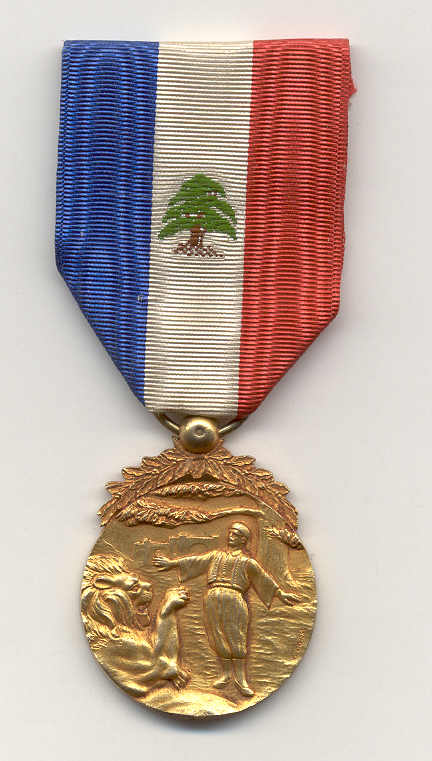
The Order was initially established during the French Mandate over Lebanon. To recognize acts of courage and devotion by Decision Number 1080 on 16 January, 1922. It was amended on 25 June, 1922. It could be awarded posthumously.
It was initially composed of four classes:
- First Class silver gilt with laurel leaf
- Second Class silver with laurel leaf
- Third Class silver without laurel leaf
- Fourth Class bronze without laurel leaf
Conditions for awarding the Lebanese Order of Merit:
- It is permitted, to award the previous holder of the Order of Merit a second similar medal degree previously obtained. However, obtaining two medals of the same degree makes the bearer eligible for a higher degree.
- Acts of courage and devotion are not enough to grant a medal, then an official congratulations letter is sent. When receiving a total of two letters this person is entitled the Fourth Class medal.
- A person loses his life or becomes disabled in an act of courage for which he is entitled the Medal. He or his family is given a temporary salary appointed by the Governor of the State of Greater Lebanon. Taking into consideration the burden of his family and his special status.
- A person loses his national status due to a court judgment. He shall lose his right to the National Order of Merit and all its benefits.
- It is not allowed to award a medal of a class from the first time unless obtained the inferior class. However, excluded from this rule a person who does a remarkable action that indicates superiority courage and devotion.
- Every recipient of the Lebanese Merit Medal shall be given a certificate issued by the Governor and the Secretary General.
The medal:
It is a round bronze medal, 30 mm in diameter, and a ribbon suspended by a ball and loop.
Obverse:
Of the four original classes, features a roaring lion and a brave Lebanese male in traditional garb protecting his village. To the lower right of the medal is the signature of the designer G. Corm: George Corm.
Reverse:
Is inscribed in French and Arabic, “HONEUR ET DEVOUEMENT” and above, “ETAT DU GRAND LIBAN”.
Ribbon:
Total width of 36 mm, tri-colour (blue, white and red), a cedar tree on the centre of the white stripe.
By Decree No. 295 on 18 December, 1943, the colours of the ribbon were changed according to the national flag: red, white and red. The white section equals both the red sections and contains a cedar tree.
The Order of Merit created by Decision No. 1080 dated 16 January, 1922; the Order of Merit is regulated by the Code of Decorations (Decree-law 122, dated 12 June, 1959), and consists of six grades:
• Extraordinary
• Grand Cordon
• First Class gilt with laurel leaf
• Second Class silver with laurel leaf
• Third Class silver without laurel leaf
• Fourth Class bronze without laurel leaf
Order of Merit classes 1,2,3 and 4:
Obverse: same as the Type I with the signature of G. Corm which was replaced in the late 1940s by the signature of Huguenin Freres, as the manufacturer and subsequently by Arthus Bertrand.
Reverse: is inscribed only in Arabic, “HONOUR AND DEVOTION” and below it, “STATE OF THE GREATER LEBANON”.
Ribbon: red, white then red,
with a cedar tree in the centre of the white stripe, forming the Lebanese flag.
The Extraordinary Grade consists of three parts:
Sash: 120 mm wide and 90 cm tall but with minor differences with different makers. It has the colours of the flag of Lebanon (independence flag), and is worn from the right shoulder down to the left hip.
Badge: attached to the sash, smaller than that of Type I, of silver with enamel, featuring a red five pointed star with the cedar tree in the centre surrounded by green enamel wreath and above the cedar tree the word “LEBANON” written in gold.
Breast Star: of silver with enamel, smaller than that of Type I, featuring a red five pointed star with green cedar leaves surrounding the word “LEBANON” written in gold.
The Lebanese Order of Merit Extraordinary Grade is granted:
To honour Heads of State
The President of the Republic, by virtue of his status, holds the Extraordinary Grade and is considered the Head of the holders of the Lebanese Order of Merit, and retains this rank (order) after the end of his term
Grand Cordon
By Law on 10 May, 1957, a special grade was created: The Grand Cordon of The Order of Merit and consists of a Sash, Breast Star and a Medal.
Breast Star: Silver disc bearing a red enamel five-pointed star with the word “Lebanon” in the middle written with Gold. With a width of 80 mm.
Medal or Badge: same as the breast star but smaller with 59 mm width.
Sash: Bi-colour, white in the middle edged by two green stripes that are both equal to the white one.
The Lebanese Order of Merit Grand Cordon Grade is granted to:
a. Heads of national and foreign legislative bodies.
b. Heads of national and foreign ministries.
c. Princes or Crown Princes.
d. Members of the Trusteeship Council
Detailed pictures of all classes and more information are found in my book, link below: